Press kit
 garmlink.ai/press
garmlink connects a Garmin account to 12 AI assistants, among them Claude, ChatGPT, Gemini and Perplexity, which then answer questions about training, sleep and recovery from that person's own data. Everything on this page may be reused freely to write about it.
Press contact, interviews and questions: sebastien@garmlink.ai.
Download
Key facts
- What it is
- A hosted connector (an MCP server) between Garmin Connect and AI assistants
- Assistants
- 12, including Claude, ChatGPT, Perplexity, Gemini, Le Chat, and Grok
- Price
- Free; an optional contribution of any amount
- Access
- Read-only: nothing is ever written to the Garmin account
- Garmin password
- Used once to sign in, never stored
- Relationship with Garmin
- Independent: neither affiliated with nor endorsed by Garmin
- Languages
- English, French, German, Spanish, and Italian
- Online since
- August 2026
- Origin
- Built in France
- Founder
- Sébastien Vassaux
What it does
- Links a Garmin account once, then keeps its activities, sleep, HRV, training load and recovery in sync.
- Lets an AI assistant answer from those numbers: how the training week went, why sleep dropped, whether a rest day is due.
- Works with 12 assistants through the Model Context Protocol (MCP), the open standard they use to read outside data, with the same address for all of them.
How it works
- Garmin watch
- Garmin Connect
- garmlink
- AI assistant
The watch syncs to Garmin Connect as usual. garmlink reads that account, with its owner's consent, and answers the assistant's questions. Nothing goes back to Garmin.
Screenshots
Captured on a demo account filled with fictitious data. Clicking an image downloads it in full size.
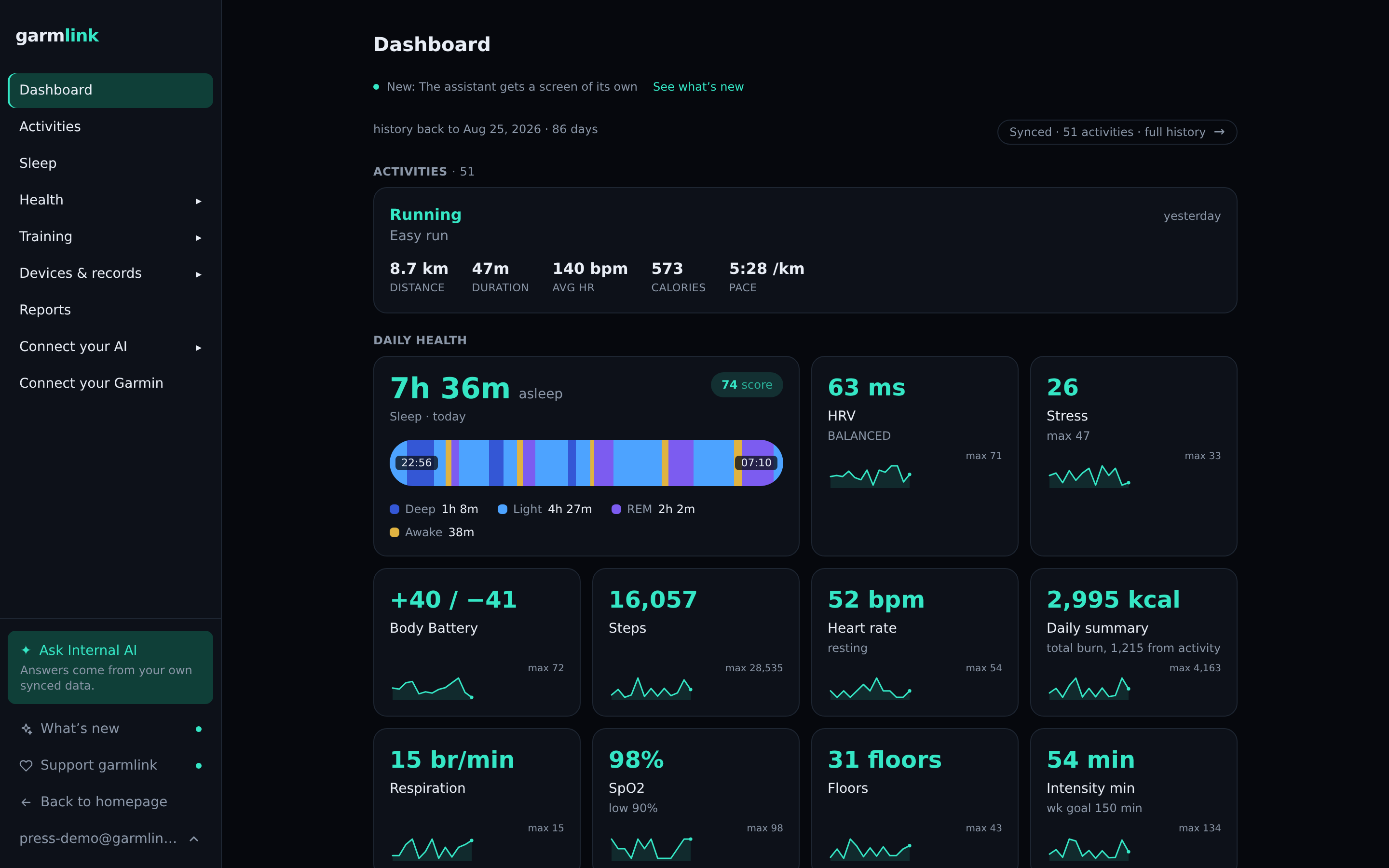
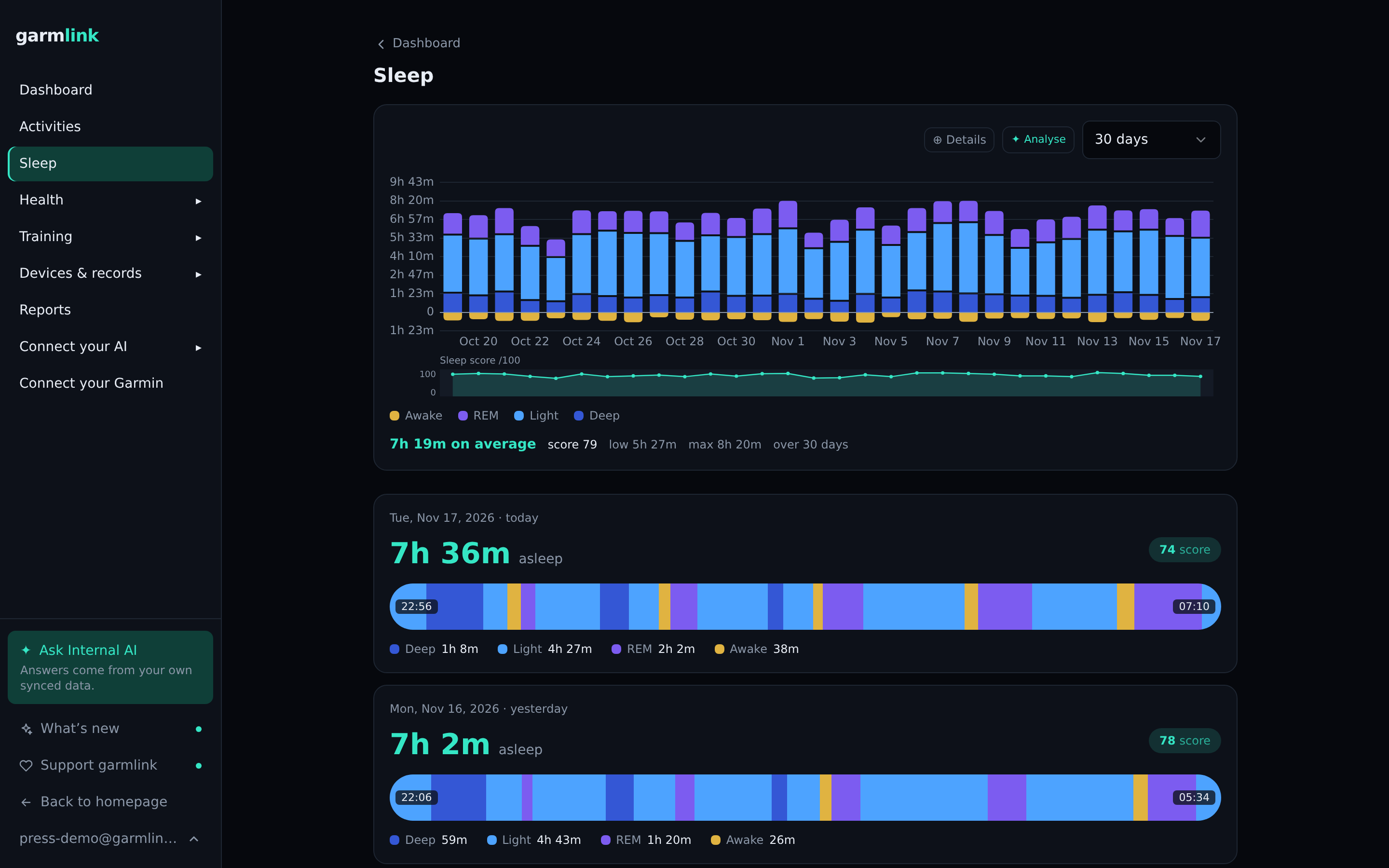
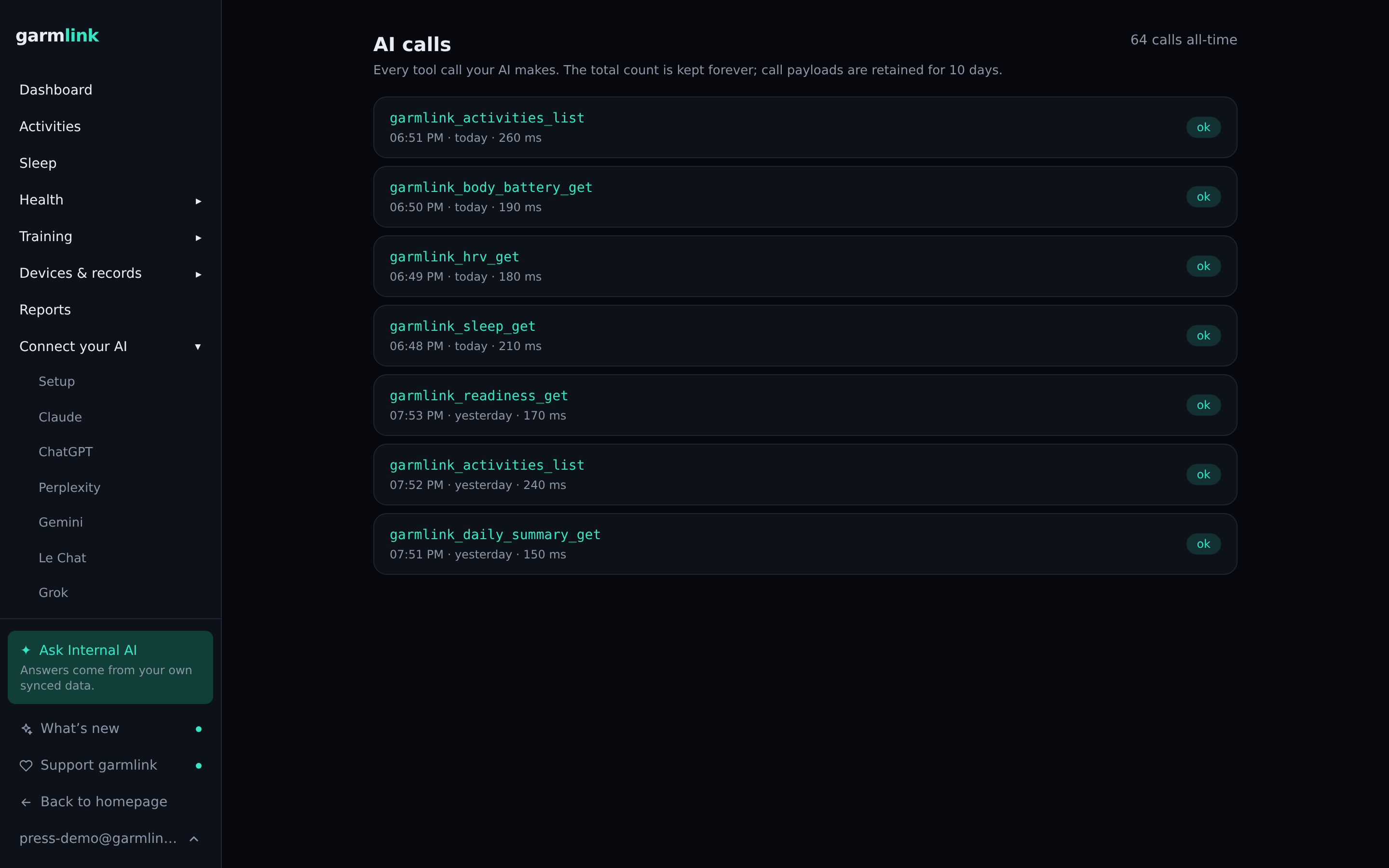
Example answers
Three typical questions put to an AI assistant connected through garmlink. These answers are examples, written on a demonstration account filled with fictitious data; a real answer draws in the same way on the person's own Garmin history. Clicking a question opens the full answer and its chart.
The founder

Sébastien Vassaux
Sébastien Vassaux is a French entrepreneur. He founded FoodMeUp, management software for the food trade, and FilterWise, which sorts property listings with AI. To meet his own need for advanced analysis, he built garmlink, which connects Garmin data to AI assistants: a fast-growing use that answers what many athletes have been asking for.
My watch recorded everything, but answering a simple question — am I recovering well? — meant going through ten screens. Now I just ask, and the answer comes from my own numbers, not from an average.
Ready-to-use texts
Free to reuse, shorten or adapt. A link to garmlink.ai is appreciated.
Short version, about 50 words
garmlink is a free service that connects a Garmin account to AI assistants such as Claude, ChatGPT, Gemini or Perplexity. Once linked, the assistant answers questions about training, sleep, HRV and recovery from the user's real data. Access is read-only and the Garmin password is never stored. garmlink.ai
Long version, about 150 words
garmlink is a free web service that connects a Garmin account to AI assistants. After a one-time link, 12 assistants, including Claude, ChatGPT, Perplexity, Gemini, Le Chat, and Grok, can read the user's activities, sleep, heart-rate variability, training load and recovery, and answer questions such as “how did my training week go?” or “why is my sleep getting worse?” from real numbers rather than general advice. It relies on the Model Context Protocol (MCP), the open standard AI assistants use to read outside data. Access is read-only: garmlink never writes to the Garmin account, the Garmin password is used once to sign in and never stored, and disconnecting deletes the synced data. The service is independent of Garmin. It is built in France by its founder, Sébastien Vassaux. It is available in English, French, German, Spanish, and Italian at garmlink.ai.
Logos and colours
The name is written in lowercase, garmlink, even at the start of a sentence. The logos with light text are drawn for dark backgrounds; the versions on their own dark tile work on any background.

- Accent
#35e6c5 - Text
#e8edf5 - Background
#06080d
Questions from the press
Is garmlink affiliated with Garmin?
No. garmlink is an independent service, neither affiliated with nor endorsed by Garmin. It signs in to Garmin Connect on the user's behalf, with their consent, to read that user's own data.
What happens to users' data?
garmlink only reads it and never writes to the Garmin account. The Garmin password is used once to sign in and never stored: only the access tokens Garmin returns are kept, encrypted. garmlink trains no AI model on the data and never sells it, and disconnecting deletes the synced data.
How does garmlink make money?
It is free and carries no advertising. An optional contribution, of the amount each user chooses, helps pay for the servers and the Garmin sync.
Can a journalist try it?
Yes, with any Garmin account: sign-up is free, and connecting one of the 12 supported assistants takes a few minutes, with a step-by-step guide for each.
For an interview, a question or a fact to check, the founder answers personally at sebastien@garmlink.ai.